
1 Amazing History Of Golf
Men and women have been rolling or hitting a ball or other small objects to get it into a hole or to a specific location since time began.
Whether it be projecting stones with a sling to kill game for food or what later became the game of golf they all follow the same principle. They just use different implements, have different purposes and do it in a different way.
As things developed to the modern age the hunting of game became regulated and so too became the game of golf.
History Of Golf
Records and Recording
No one knows anything about anything unless it is recorded and the same is true of the beginnings of the game of golf.
History Of Golf
Harry Vardon – The Vardon Grip
Culmination of a Fascination
Golf – The Basics
Golf is simply the culmination of a long-standing fascination of men and women with striking a ball toward a target.
Players
Golf is a game played by one to four players hitting a ball with the objective of getting it into a hole in as few a strokes as possible.
History Of Golf
Method
Starting from a tee the ball is struck towards a normally flat green when it is then putted into the hole.
Implements
Various clubs are used each with different weights to give different distances.
Strokes For The Hole
To cater for different individual golfing skills each hole has a set number of strokes known as Par for the hole or course. Each hole is assessed for difficulty which is normally done by the club professional.
History Of Golf
Handicap System
A handicap system is in place with each player allocated a number of strokes relevant to their different skills of playing to ensure fairness so that every player has the same chance.
What Is A Game?
A game can be one hole or a series of holes.
How Many Holes?
The accepted normal golf course is either 9 holes or 18 holes. Courses can be of any distance.
History Of Golf
Longest Known Golf Course
The longest known golf course in the world is in Australia and opened 22nd October 2009 from an idea by Alf Caputo and Bob Bongiorno over a bottle of red wine.
Both active in the Eyre Highway Operators Association. They came up with the idea whilst at the Balladonia Roadhouse talking about ways to reduce driver fatigue and boredom of driving long distances. It also included how the Roadhouses along the way could generate more trade.
History Of Golf
Nullarbor Links Golf Course
The Nullabor Links Golf Course is believed to be the longest in the world. It is an 18-hole par 72 at 1,365 km or 848.17 miles long.
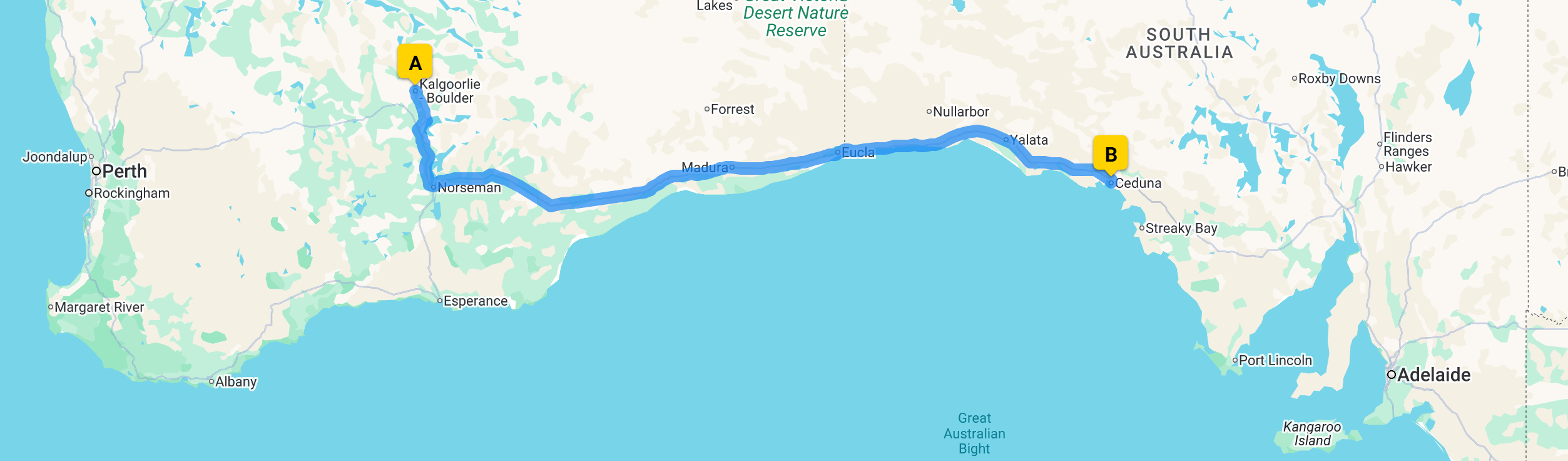
It is on the southern coast of Australia following the Eyre Highway crossing the two states of South Australia and Western Australia.
At one point it crosses the Nullarbor Plain, a flat, almost treeless, arid, semi-arid land of 200,000 square km or 77,000 square miles.
Kalgoorlie WA – Ceduna SA
The course can be played in either direction and is located between Kalgoorlie, a goldmining town in Western Australia and the coastal town of Ceduna, South Australia.
Robert Stock, a Professional Golfer from Manchester, UK consulted on the design which has an average distance between holes of 66 kilometres or 41 miles. The longest distance is almost 200 kilometres or 120 miles.
7 holes are from existing courses and 11 holes were specially created at roadhouses and roadside stops. Tees and greens use artificial grass with natural desert land between. Players buy a scorecard for stamping at the roadhouses en route with thousands having played the course since it opened.
Natural Hazards
Natural hazards include daytime temperatures that can reach over 50 °C (122 °F), crows, emus, kangaroos, three species of deadly venomous snakes, wedge-tailed eagles and wombat holes.
The Encyclopedia Britannia describes golf as, ‘A cross-country game in which a player strikes a small ball with various clubs from a series of starting points (teeing grounds) into a series of holes on a course. The player who holes his ball in the fewest strokes wins.’
History Of Golf
Scotland Origins
It is generally believed that golf started is Scotland. This is only partially true. However it could be said that golf in its present regulated form and popularity started in Scotland.
Why Scotland? Where did the idea of the game come from? Who told someone in or from Scotland about similar games? Did anyone tell them or did they invent it themselves from scratch? This article, by researching the various facts and information available, tries to pull together and coordinate the different views and seeks to go someway to answer these questions.
History Of Golf
Origin of the Word Golf
The Dutch word kolf or kolve, meaning “bat” or “club” is where the name golf originated from. A stick used in a game is called kolvn.
History Of Golf
Romans and Chinese
The foundations may have been laid by the Romans who played a game called “Paganica” in the first century or the Chinese who played a game called “chuiwan” during the Song Dynasty (960-1279).
History Of Golf
Paganica The Place
Paganica is not only the name of a game played by the Romans but also an old Roman city located centrally towards the south of Italy. It is a hillside town 669 metres above sea level in the Abruzzo region.
On 6th April 2009 Paganica was the nearest town to the epicentre of an earthquake that rocked Italy. It had 70 per cent of it’s buildings destroyed.
History Of Golf
Paganica The Game
Using a wool or feather stuffed leather ball the Romans would use a bent stick to hit the ball. It is thought that during the 1st century BC the game of Paganica was introduced to the various European countries as each was conquered by them. When golf did start early golf balls had a similar construction.
History Of Golf
Chuiwan The Game
Played and popular in China during the 13th Century Chuiwan or Chui Wan (“Chui” means hitting and ”wan” means small ball in Chinese) bat and ball game had similarities to putting in golf. As in much of Chinese culture it also had an inbred politeness and etiquette similar to that of golf.
History Of Golf
Song Dynasty
It is said that the game goes back to the Song Dynasty of 943 AD and was a favourite game amongst palace maids and ordinary people.
Emperors also played it with the imperial clubs inlaid with precious stones and gold.
The game was rarely played during the Oing Dynasty which followed the Song Dynasty.
History Of Golf
Wanjing – Ball Treatise
Chuiwan was popular with Royals and non Royals alike and played for several hundred years at the royal Chinese court. The rules were called Wanjing, meaning ‘ball treatise’. These rules were probably written in about 1182 but not published until 1282.
History Of Golf
Ming Dynasty
The first known player of Chuiwan was Emperor Xuanzong of the Ming dynasty (1426-1435). Born as Zhu Zhanji in 1399 he reigned under the title of Xuande.
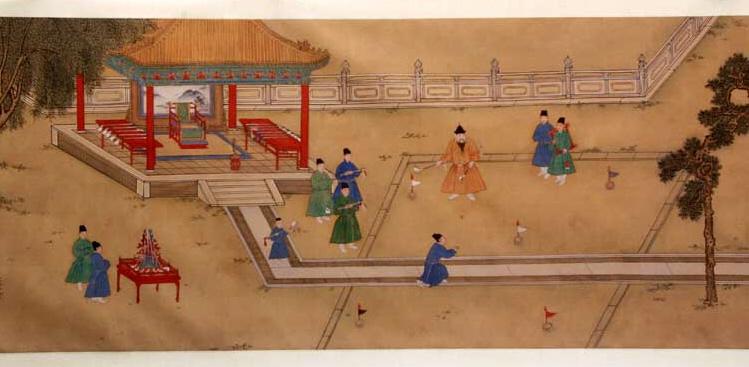
Picture shows painting by unknown Ming artist, painted on silk during the Xuande era (1426–1435) of Emperor Xuanzong at Leisure. In the painting, the Xuande Emperor is depicted playing CHUIWAN, a Chinese game, with eunuchs.
History Of Golf
How It Was Played
Chuiwan is like a very short pitch and putt game but has been described as similar to golf. It was played with wooden balls and iron head clubs on a prepared area of ground, similar in size to a large practice putting area.
History Of Golf
Chuiwan Connection With Golf
Both Chuiwan and Golf have similarities. Complex rules, hitting balls towards holes and above all gentlemanly etiquette. However this is where it ends. The rules, balls, scoring, course and clubs are all different.
Some historians have propositioned that golf was directly influenced by Chuiwan and brought to Europe by the Mongols or merchants.
This has generally been dismissed. There is no proven evidence between Chuiwan and either golf or other ‘hit ball’ games in Europe.
It has also been suggested that Europeans at the Chinese Court in the 13th century may have brought it to Europe. However this is again unlikely as there were aspects of Chuiwan such as raised tee, flags, bags, scoring with a slight resemblance to Stableford that were not present when golf started to develop in Europe.
In addition the second stroke in Chuiwan was made from a squatting position. This is called ‘hitting with low knees’.
History Of Golf
Stick and Ball Games Europe
Over the years there were and are many Stick and Ball Games with their own rules and ways of playing. Some of these resemble aspects and elements of golf. A small number of the various games are listed below with their associated countries.
History Of Golf
Kolf – Netherlands
Kolven is the (verb) or Kolf the (noun). It can also be referred to as Colf.
It is said that the name Golf originates from the name Kolf.
Played by four people the objective is to hit the ball using a club and taking 3 strokes over a certain distance. The first stroke hits the pole at the far end and then everything is reversed and reversed again. On the 3rd stroke the player nearest to the end wall gets the most points. Games can last multiple days. It was traditionally played with a glass of
Jenever (Dutch Gin) or a cigar.
The Kolf Club (Kliek Dutch) had a heavy metal head and a very strong wooden shaft and depending on the balls used required different size clubs.
Although originally played outdoors it is now played indoors with very, very few locations remaining. It became a favourite with cafe owners and the like to boost trade but many closed as being uneconomic.
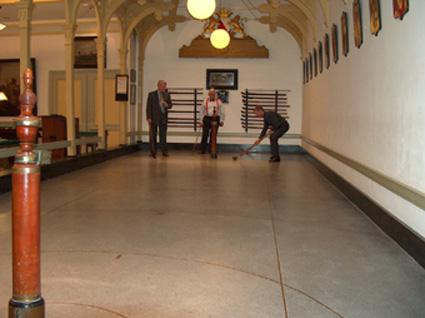
A Kolf court in St. Eloy’s Hospice in Utrecht. Note the posts in the middle either end.
The game dates back to at least 1261 when first reference is made in Dutch to a game with “mit ener coluen” (with a colf/kolf club). It appeared in a Middle-Dutch manuscript by Boeck Merlijn written by the Flemish poet Jacob van Maerlant.
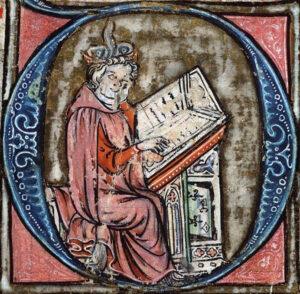
Jacob van Maerlant (c. 1230–40 – c. 1288–1300) was a Flemish poet of the 13th century and one of the most important Middle Dutch authors during the Middle Ages.
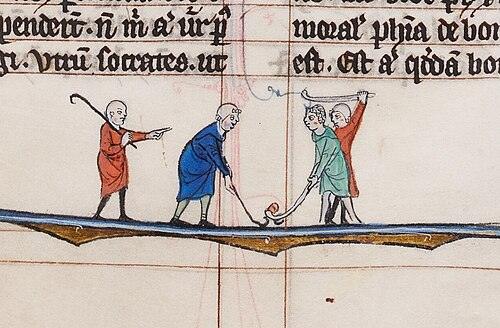
This scene in the margins of a late 13th-century manuscript depicts a game with clubs and a ball, possibly the game of kolf referred to by Jacob van Maerlant. It is considered to be the earliest known depiction of a golf-like game. It is held at the Bruges Public Library.
The game spread to what is now Belgium and it is known to have been banned in Brussels in 1360. The reason – too many broken windows.
See the link Chole and Jeu de Mail had to the Dutch developing the game of Kolf/Colf.
History Of Golf
Chole – Belgium & France
It is said that Chole was probably the closest to modern golf. Played with a wooden ball and iron headed clubs the aim was to reach a given target in the minimum number of strokes.
History Of Golf
Jeu de Mail – France
Similar to Chole but played with a metal hammer either on a course or cross country.
History Of Golf
Beugelen – Netherlands
This involves hitting the ball through a narrow gap on the course. Beugelen still survives today in the Dutch province of Limburg in the south.
History Of Golf
Klosbaan – Netherlands
Like Beugelen this also involved hitting the ball through a narrow gap on the course.
History Of Golf
Linking Games Together
Colf is believed to be combination of the Belgium game of Chole and French game of Jeu de Mail and that the Dutch adapted it to make their own Dutch game of Kolf or Colf.
History Of Golf
Chuiwan Connection With Kolf/Colf
There are 16th century illustrations in existence that show the Dutch game Colf being similar to Chuiwan.
Neil Laird on his website scottishgolfhistory.org found three points of similarity in the illustrations between Chuiwan and Colf. Neil makes the point that there may just be a possible connection between Chinese Chuiwan and Dutch Colf.
If there were to be any connection between the two Neil then goes on to add a very intriguing and interesting suggestion.
The connection between the great philosopher Confucius and modern day golfers.
History Of Golf
The formal name of the philosopher Confucius who lived 551-479 BCE is Kǒng Fūzǐ, meaning Grand Master Kong. Confucius is the latinization of Kǒng Fūzǐ.
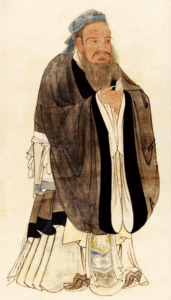
His teachings, many years after his death were written up as ‘sayings’, called Analects, and attributed to him. The cornerstones were of respect and a strong family unit.
The basic foundation of respect and etiquette of Chuiwan and Confucian philosophy was based on doing things ‘properly’. This is noted in Analect 3.7 which Neil quotes.
Quote ‘There is nothing which gentlemen compete over, but they go up, bowing to each other, and when they come down they have a drink. So, even in their competition with each other, they are gentlemen.’
How very civilized!
Neil asks the question. “Did elements of Chuiwan find its way to Europe and affect, directly or indirectly, the development of colf or golf?”
If so, with its respect and etiquette, all golfers are modern day followers of Confucius whether realising it or not.
History Of Golf
How Did Golf Reach Scotland?
It is believed that merchants travelling between the ports of St Andrews on the east coast of Scotland and Holland and other *Hanseatic ports where the game was popular may have brought back this, at the time, very outdoor game of Kolf/Colf to Scotland.
*Hanseatic League dominated maritime trade in the North and Baltic Seas and led to early trading agreement of various European ports from 1200. Eventually it stretched as far as Bergen in the north, Tallinn in Estonia in the east, Poland and the German ports and Netherlands in the west encompassing some 200 settlements.
Once in Scotland Kolf/Colf was refined and altered. So developed the first rudimentary elements to make it into what is now the glorious game of golf.
It is not known when it arrived in Scotland but is reported that Mary Queen of Scots played golf at Musselborough.
As a girl Mary Queen of Scots was brought up in France and as a member of the French Royal Family learnt to play the equivilent game of the day. However, being Royalty, military cadets were tasked with carrying her clubs. From this it is likely that the term ‘Caddy’ evolved.
History Of Golf
What We Know So Far!
So far what the research shows is that over the centuries there is a possible link between a game played in China having a possible influence on games in Belgium and France and Holland.
That a new game developed by the Dutch may have been influenced by the games in Belgium and France.
That the new game developed by the Dutch could have been carried over as an idea to Scotland who they themselves made it into their own and what is now know as Golf.
History Of Golf
Time Line -What Happened When Chole Reached Scotland
Development of Golf Partial Timeline
1421 – A Scottish regiment aiding the French against the English at the Siege of Baugé is introduced to the game of chole. Hugh Kennedy, Robert Stewart and John Smale, three of the identified players, are credited with introducing the game in Scotland.
1457 – Golf, along with football, is banned by the Scots Parliament of James II to preserve the skills of archery. Golf is prohibited on Sundays because it has interfered with military training for the wars against the English.
1470 – The ban on golf is reaffirmed by the Parliament of James III.
1491 – The golf ban is affirmed again by Parliament, this time under James IV.
History Of Golf
1502 – With the signing of the Treaty of Perpetual Peace between England and Scotland, the ban on golf is lifted.
James IV makes the first recorded purchase of golf equipment, a set of golf clubs from a bow-maker in Perth.
1513 – Queen Catherine, queen consort of England, in a letter to Cardinal Wolsey, refers to the growing popularity of golf in England.
1527 – The first commoner recorded as a golfer is Sir Robert Maule, described as playing on Barry Links, Angus (near the modern-day town of Carnoustie).
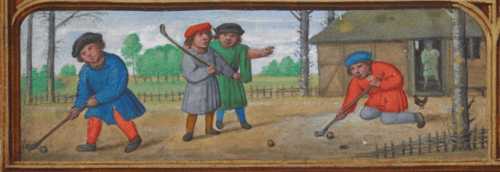
The Golf Book (British Library Add MS 24098) is the common name for an illuminated manuscript Book of Hours in the Use of Rome, dating from the 1540s. Only 23 pages remain of the original work created by the renowned illuminator Simon Bening and his studio in Bruges. It owes its popular name to one illustration in the calendar, depicting people playing a game resembling golf. The book is believed to have been created for a Swiss patron. It should not be confused with the rules of golf.
1552 – The first recorded evidence of golf at St. Andrews, Fife.
1553 – The Archbishop of St Andrews issues a decree giving the local populace the right to play golf on the links at St. Andrews.
1567 – Mary, Queen of Scots, seen playing golf at Seton Palace shortly after the death of her husband Lord Darnley, is the first known female golfer.
1589 – Golf is banned in the Blackfriars Yard, Glasgow. This is the earliest reference to golf in the west of Scotland.
1592 – The Royal Burgh of Edinburgh bans golfing at Leith on Sunday “in tyme of sermonis.” (Eng: sermons)
History Of Golf
1618 – King James VI of Scotland and I of England confirms the right of the populace to play golf on Sundays.
1621 – First recorded reference to golf on the links of Dornoch (later Royal Dornoch), in the far north of Scotland.
1641 – Charles I is playing golf at Leith when he learns of the Irish rebellion, marking the beginning of the English Civil War. He finishes his round.
1642 – John Dickson receives a licence as ball-maker for Aberdeen.
1650 – In December 1650, the settlers of Fort Orange (near present-day Albany, New York) played the first recorded round of kolf (golf) in America. The Dutch settlers played kolf year round. During the spring, summer and fall it was played in fields. In the winter it was played on ice with the same rules. Then on December 10, 1659, the ruler passed an ordinance against playing golf in the streets of the same city.
History Of Golf
1650 – On a Monday in December of 1650 a party of men came to his [Steven Jansz] house [house with attached tavern] to drink after having played a round of “kolf” for brandy … Sometime during the drinking session Teunis Jansz Seylemaecker (Sailmaker) accused Steven Jansz’ wife Maria [Tavern Keeper] of having ‘wiped out two strokes at once’ although she had tapped [poured] two “roamers” [green wine glasses] of brandy.
Apparently the losers of the match were required to pay the wager to Maria upon arrival at the tavern. She then recorded the amount with chalk on a piece of slate as credit toward the brandy to be consumed by the winners. Each stroke on the slate probably represented two ‘roemers’ of brandy, or a round for the two men on the winning team.” Eventually, two of the men, Philip Pietersz Lademaecker and Steven [Jansz], began fighting. The two other players, which included Gijsbert Cornelisz, joined. Gijsbert and Steven ended up killing each other over the accusations but managed to apologize to each other before dying
1658 – Golf is banned from the streets of Albany, New York. One of the first references to golf in America.
1682 – In the first recorded international golf match, the Duke of York and John Patersone of Scotland defeat two English noblemen in a match played on the links of Leith.
Andrew Dickson, carrying clubs for the Duke of York, is the first recorded caddie.
1687 – The student diary of Thomas Kincaid includes his Thoughts on Golve, and contains the first instructions on playing golf and an explanation of how golf clubs are made.
History Of Golf
1721 – Earliest reference to golf on Glasgow Green, the first named course in the west of Scotland.
1724 – “A solemn match of golf” between Alexander Elphinstone and Captain John Porteous becomes the first match reported in a newspaper. Elphinstone fights and wins a duel on the same ground in 1729.
History Of Golf
1735 – The Royal Burgess Golfing Society of Edinburgh is recorded as having formed; it claims to be the oldest golfing society in the world.
1743 – Thomas Mathison’s epic The Goff is the first literary effort devoted to golf.
1744 – The Honourable Company of Edinburgh Golfers is formed, playing at Leith links. It is the first golf club.
The Royal Burgh of Edinburgh pays for a Silver Cup to be awarded to the annual champion in an open competition played at Leith. John Rattray is the first champion.
1754 – Golfers at St. Andrews purchase a Silver Cup for an open championship played on the Old Course. Bailie William Landale is the first champion.
The first codified Rules of Golf are published by the St. Andrews Golfers (later The Royal and Ancient Golf Club of St Andrews).
1759 – Earliest reference to stroke play, at St. Andrews. Previously, all play was matchplay.
1761 – The Bruntsfield Links Golfing Society of Edinburgh is formed.
1764 – The competition for the Silver Club at Leith is restricted to members of the Honourable Company of Edinburgh Golfers.
The first four holes at St. Andrews are combined into two, reducing the round from twenty-two holes (11 out and in) to 18 (nine out and in). St. Andrews is the first 18-hole golf course and sets the standard for future courses.
1766 – The Blackheath Club in London becomes the first golf club formed outside Scotland.
1767 – The score of 94 returned by James Durham at St. Andrews in the Silver Cup competition sets a record unbroken for 86 years.
1768 – The Golf House at Leith is erected. It is the first golf clubhouse.
1773 – Competition at St. Andrews is restricted to members of the Leith and St. Andrews societies.
1774 – Thomas McMillan offers a Silver Cup for competition at Musselburgh, East Lothian. He wins the first championship.
The first part-time golf course professional (at the time also the greenkeeper) is hired, by the Edinburgh Burgess Society.
1780 – The Society of Golfers at Aberdeen (later the Royal Aberdeen Golf Club) is formed.
1783 – A Silver Club is offered for competition at Glasgow.
1786 – The South Carolina Golf Club is formed in Charleston, the first golf club outside of the United Kingdom.
The Crail Golfing Society is formed.
1788 – The Honourable Company of Edinburgh Golfers requires members to wear club uniform when playing on the links.
1797 – The Burntisland Golf Club is formed.
The town of St. Andrews sells the land containing the Old Course (known then as Pilmor Links), to Thomas Erskine for £805. Erskine was required to preserve the course for golf.
History Of Golf
1806 – The St. Andrews Club chooses to elect its captains rather than award captaincy to the winner of the Silver Cup. Thus begins the tradition of the Captain “playing himself into office” by hitting a single shot before the start of the annual competition.
1810 – Earliest recorded reference to a women’s competition at Musselburgh.
1824 – The Perth Golfing Society is formed, later Royal Perth (the first club so honoured).
1828 – The first references indicating that hickory was used for golf shafts appears in identical articles in The Sporting Chronicle and The Sporting Magazine.
1829 – The Dum Dum Golfing Club, later Calcutta Golf Club (and later still Royal Calcutta) is formed.
1832 – The North Berwick Club is founded, the first to include women in its activities, although they are not permitted to play in competitions.
1833 – King William IV confers the distinction of “Royal” on the Perth Golfing Society; as Royal Perth, it is the first Club to hold the distinction.
The St. Andrews Golfers ban the stymie, but rescind the ban one year later.
1834 – William IV confers the title “”Royal and Ancient” on the Golf Club at St. Andrews.
1836 – The Honourable Company of Edinburgh Golfers abandons the deteriorating Leith Links, moving to Musselburgh.
The longest drive ever recorded with a feathery ball, 361 yards, was achieved with a following wind by Samuel Messieux on the Old Course at St Andrews.
1842 – The Bombay Golfing Society (later Royal Bombay) is founded.
1844 – Blackheath follows Leith in expanding its course from five to seven holes. North Berwick also had seven holes at the time, although the trend toward a standard eighteen had begun.
1848 – Invention of the “guttie,” the gutta-percha ball. It flies further than the feathery and is much less expensive to make. It contributes greatly to the expansion of the game.
John Reid – USA Father of Golf
1888 – The oldest surviving golf club in America is the St. Andrews Golf Club founded in Yonkers, N.Y. by John Reid of Dunfermline, Scotland.
John Reid was known in America as the ‘Father of Golf’.
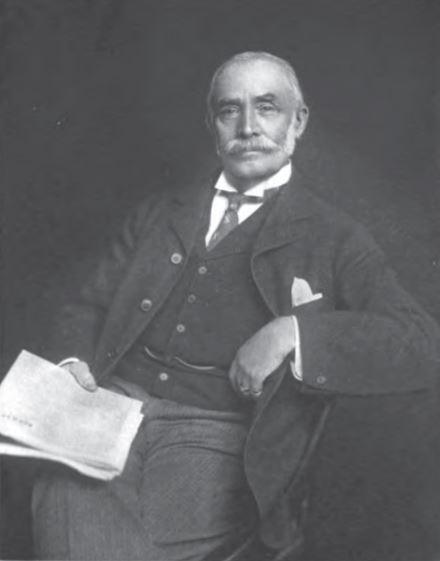
John Reid America ‘Father of Golf’
1895 – The first 18-hole golf course in the United States opened at Chicago Golf Club.
1895 – The United States Golf Association (USGA) was founded. The five founding clubs were 1. Saint Andrew’s Golf Club Yonkers New York 2. Shinnecock Hills Golf Club, New York 3. Chicago Golf Club, Illinois 4. Newport Country Club, Rhode Island 5. The Country Club, Massachusetts
1901 – The Professional Golfers’ Association (PGA) is formed.
1921 – The ball is limited in size and weight by the R & A.
1927 – The first inaugural Ryder Cup Match between Britain and the United States is played.
1933 – Official accepted standard for golf courses being 18 holes.
1934 – Initially known as the ‘Augusta National Invitation Tournament’ the first Masters was held 22-25 March at Augusta, Georgia, USA. It has continued to be played at Augusta since.
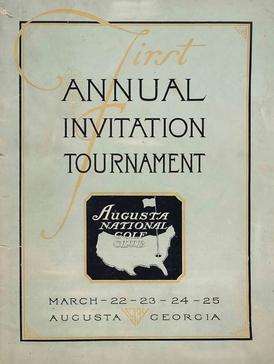
Official Programme First Masters Tournament 22-25 March 1934 Augusta, Georgia, USA.
1954 – Architect Robert Trent Jones, upon receiving complaints that he has made the par-3 fourth hole at Baltusrol too hard for the upcoming U.S. Open, plays the hole to see for himself and records a hole-in-one.
The Baltusrol Golf Club is a private 36-hole golf club in the eastern United States, located in Springfield, New Jersey about 30 miles from New York.
History Of Golf
Robert Trent Jones Sr.
Golf Course Architect Robert Trent Jones Sr. (June 20, 1906 – June 14, 2000) was British–American who designed or re-designed more than 500 golf courses in 45 U.S. states and 35 countries.
He was born on June 20, 1906, in Ince-in-Makerfield, England, to Welsh parents. In about 1912 age five or six, Jones emigrated with his parents to the United States arriving East Rochester, New York.
Golf Record
1992 – Simon Clough and Boris Janic completed 18-hole rounds in five countries in one day, walking each course. They played rounds in France, Luxembourg, Belgium, Holland, and Germany, and completed their journey in 16 hours, 35 minutes.
History Of Golf
Golf TV
1993 – Joe Gibbs and Arnold Palmer together with others in a joint ownership group announce plans for a Golf Channel
1995 – The Golf Channel launched a 24-hour, 365-day cable service.
History Of Golf
PGA
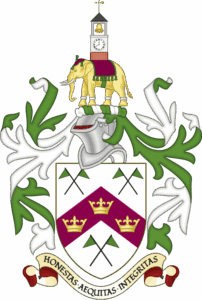
Coat of Arms of Professional Golfers’ Association Note the motto Honestas Aequitas Integritas (Honesty, Justice as in Fairness and Integrity)
The PGA is the Professional Golfers’ Association. It is based at The Belfry near Sutton Coldfield in West Midlands. It is a members’ organisation and educates and trains PGA Professionals to degree level with the very latest skills and expertise. This includes Club Management as well as teaching skills.
1901 – Legendary golfing players of the day of JH Taylor, James Braid and Harry Vardon were able to gain enough support to form the London and Counties Golf Professionals’ Association. This was formed on 9th September 1901 and the first AGM on the 2nd December 1901, the name was changed to ‘The Professional Golfers’ Association‘ which still exists today.
From an idea by a Professional Golfer in North Wales it started with 59 professional golfers and 11 assistant professionals.
A very male dominated game the Women’s Professional Golfers’ Association (WPGA) was established in 1978 and became a recognised part of the wider PGA.
The PGA now has approximately 8000 golf professionals and golf assistants as members located in 80 countries.
It provides a vast range of playing opportunities for its Members by organising more than 700 tournaments every year. Events range from local pro-am competitions to national finals and international events.
History Of Golf
R & A
The Royal and Ancient Golf Club of St Andrews for brevity was affectionately and still is known as the R & A, an organisation responsible for the rules and as a governing body of golf.
2004 – The R&A reverted to a group of three companies.
2004 – The Royal and Ancient Golf Club of St Andrews became a member only club
2004 – The three companies each of which the R&A Group became sole owners is responsible for Rules, Competitions and Services. Each is an entity in its own right. R&A Rules Limited, R&A Championships Limited, and R&A Group Services Limited.
The governing body of golf worldwide are R&A Rules Limited. They rule countries worldwide except for the United States. The US Golf Association (USGA) rules the USA and Mexico.
Both R&A and USGA share a single code for the Rules of Golf, Rules of Amateur Status, Equipment Standards and World Amateur Golf Rankings.
History Of Golf
Harry Vardon – The Vardon Grip
Harry Vardon was not only a great player and one of the prime movers of the starting the PGA but also made famous the Vardon Grip. This is still relevant today and many golfers will be using the grip without perhaps realising its origins.
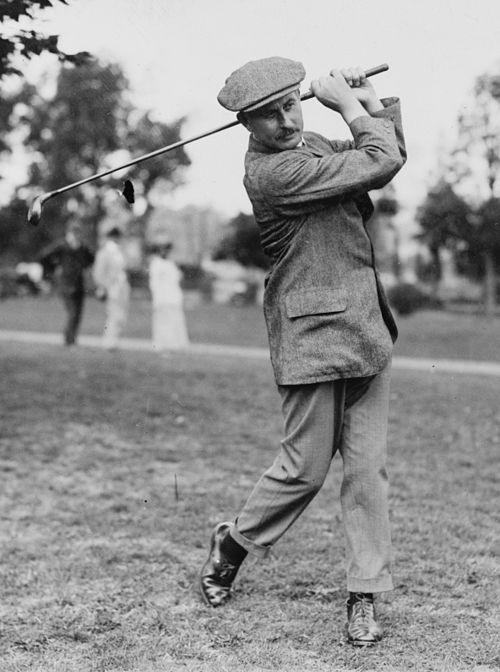
Harry Vardon
History Of Golf
John Ernest Laidlay
However many may not realize it but it was a Scottish amateur golfer called John Ernest Laidlay (5 November 1860 – 15 July 1940) who actually invented the most popular golf grip used today. Harry Vardon took up the grip after Laidlay and it became known as the Vardon Grip.
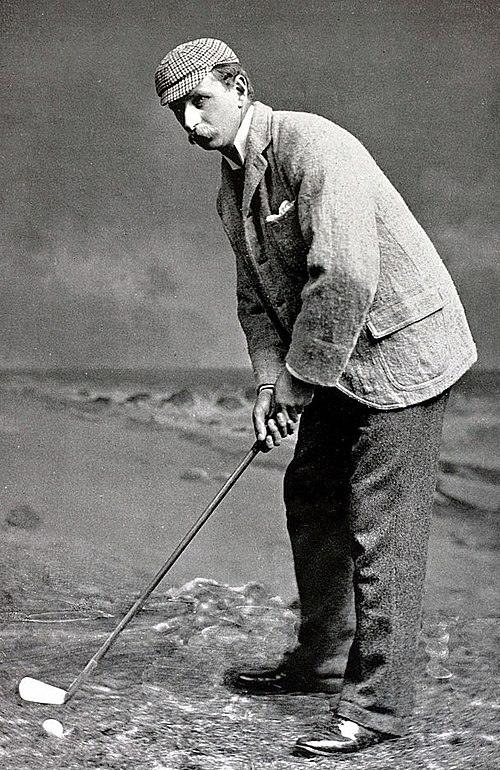
John Ernest Laidlay 5 Nov 1860 – 15 July 1940
The overlapping grip, the grip most popular among professional golfers. In the Vardon grip, one places the little finger of the trailing hand (the one placed lower on the club – right hand for a right-handed player) in between the index and middle finger on the leading hand (the hand that is higher on the club). The leading-hand thumb should fit in the lifeline of the trailing hand.
History Of Golf
Frank Barney Gorton Stableford
Frank Barney Gorton Stableford (1870–1959) is a legend in golf. Nearly every single day a golfer is playing he is thinking of scoring and thinking of a scoring system brought into being by Frank Barney Gorton Stableford.
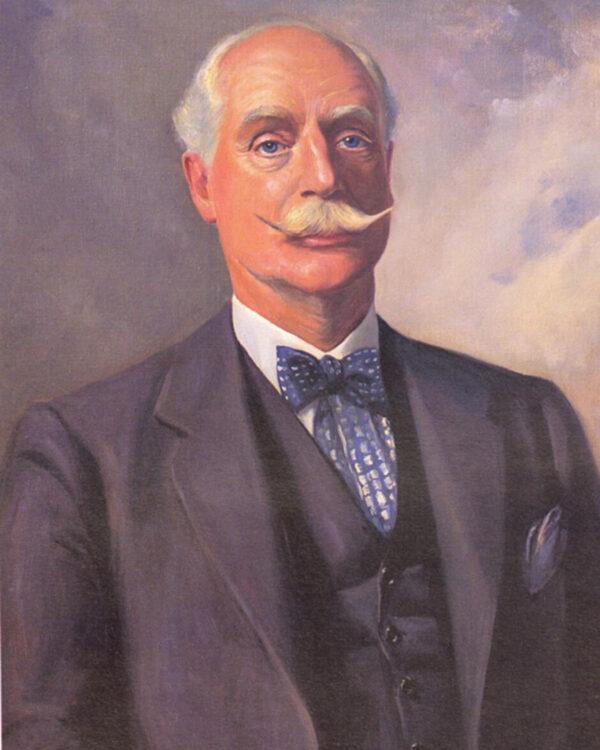
Frank Barney Gorton Stableford was medical Doctor who had served as a surgeon in the Royal Army Medical Corps. He spent some years in South Africa.
He experimented with a scoring system whilst a member of Glamorganshire Golf Club in Penarth at Royal Porthcawl but it did not work.
He was Major in the Royal Army Medical Corps during 1914-1918 World War 1 and after the war went to Wallasey where he joined the Wallasey Golf Club.
In the 1920’s he was a member of Anglesey Golf Club for many years before joining Wallasey.
Some years later fed up with seeing players tear up their playing cards in frustration after just a couple of holes he developed a new scoring system.
This was Stableford and a great success around the world to this day.
1932 – Wallasey held the first Stableford competition on 16th May 1932, and it was an instant success.
History Of Golf
Why 18 Holes?
Golf courses each originally had a different number of holes on different courses and were not always played in any particular order. Here are just three examples of how different clubs originally designed or started the layout of their courses.
Leith Links in 1744 had 5 holes adding 2 holes later.
Musselburgh Old Course had 7 holes for a number of years with an 8th added in 1832 and a 9th hole in 1870.
Montrose Links had 7 holes by 1810, increased to 14 holes by 1825, reduced to 11 holes by 1849 and increased to 25 holes by 1866 and reduced again sometime shortly after 1874.
History Of Golf
18 Holes
The Old Course at St Andrews established in 1552 is the source of why golf courses have 18 holes.
Originally, the course had 22 holes, with 10 holes played twice, and holes 11 and 22 played only once.
William St Clair of Roslin in 1754 believing they were too short merged the first four holes of the course into two.
Later in 1797 it survived bankruptcy and a dispute with rabbit farmers over the land.
Later in 1797 it survived bankruptcy and a dispute with rabbit farmers over the land.
History Of Golf
First Open Championships
The first Open Championships were held at St Andrews in 1879
Land Bought By R & A
Then in 1893 the nephew of James Cheape, who was a golfer and who had earlier bought the land sold it to The Royal and Ancient Golf Club of St Andrews.
History Of Golf
The Old Course
Two years later in 1895 the course was renamed The Old Course.
History Of Golf
Parliamentary Act
The course is also subject to a Parliamentary Act of 1974 by the St Andrews Link Trust
The implications of this are that it is open to the public even though the St Andrews golf clubs hold playing rights.
History Of Golf
Influence Of Competitions
Many tournaments have been held at St Andrews and The Royal and Ancient Golf Club of St. Andrews, St. Andrews Golf Club and The New Golf Club have all been founded near the course.
It appears that the increasing number of competitions was a factor in 18 hole courses being the accepted standard. With The Royal and Ancient Golf Club of St. Andrews this helped to cement it as a leader of golf rules and protocol.
An 18 hole round was set out by The Royal & Ancient in their 1842 Rules even though their course was not 18 holes at that time. The mention of 18 holes also appears in the Rules of 1858 and 1875 but not 1888.
The Royal and Ancient Golf Club actively promoted the 18 hole format of golf courses. Members joining other golf courses also spread the word and as a result multiple 18-hole courses followed.
History Of Golf
Accepted Standard 1933
The official accepted standard for golf courses being 18 holes occurred in 1933
Endorsed & Stipulated 1950
Under the Rules of Golf of 1950 18 holes was officially endorsed and later stipulated as being the normal official round.
History Of Golf
Royal Clubs
To receive the honour of Royal status by the British Monarchy a golf club is required to invite a member of the Royal family to be a patron or an honorary member. Alternatively they can formally apply for the title which if approved is then granted by the current reigning monarch. The club can then use the word Royal in the title of their club.
Altogether there are a total of 64 golf clubs granted Royal status by British Monarchs. These clubs are located both within the UK and around the world. The status of Royal having been conferred on them from 1833 in the reign of King William IV to the present day.
The list is below and thanks must go to Matt Chivers, a golf journalist for National Club Golfer (NCG) and also a member of Royal Cinque Ports Club in Deal, Kent for its compilation.
The Ryder Cup
One of the most well known events in the golfing world is the Ryder Cup.
The Ryder Cup is intended to be a friendly competition between teams from the United States and originally Great Britain but now includes Europe. None of the players receive
any prize money.
It is played every two years either odd or even depending on world events that prevent it.(Wars/COVID etc).
The very first official Ryder Cup match was played at Gleneagles Golf Course in. Scotland in 1927 although similar matches had been held as early as 1920.
The competition is named the Ryder Cup after Samuel Ryder who sponsored it and donated a gold trophy.
History Of Golf
Samuel Ryder
Samuel Ryder was a British businessman and golf promoter who became wealthy from selling one penny garden seed packets by post.
A Lancasterian, he was born on 24 March 1858 in Walton-le-Dale, Lancashire, England.
It was not until he was 50 that he took up golf on health grounds to get more fresh air. An enthusiastic amateur Samuel Ryder got down to a single-figure handicap.
He was a member of Verulam Golf Club near St Albans Hertfordshire and for over 20 years was on the greens committee. A large donor to the club he was Captain 1911, 1926 and 1927.
Later he was also captain of the Stratford-upon-Avon Golf Club in 1929 and 1930.
He died 2 January 1936 (aged 77) in London England and is buried in Hatfield Road Cemetery, St Albans, UK.
History Of Golf
Royal Golf Clubs in the UK
Granted Royal status King William IV 21.08.1765 – 20.06.1837
Royal Perth (1833)
The Royal & Ancient St Andrews (1834)
History Of Golf
Granted Royal status Queen Victoria 24.05.1819 – 22.01.1901
Royal Montrose Mercantile (1845)
Royal Blackheath (1845)
Royal North Devon (1867)
Royal Liverpool (1871)
Royal Musselburgh (1876)
Royal Wimbledon (1882)
Royal Isle of Wight (1883)
Royal Belfast (1885)
History Of Golf
Royal Ascot (1887)
Royal Eastbourne (1887)
Royal Cromer (1888)
Royal Epping Forest (1888)
Royal Guernsey (1891)
Royal Cornwall (1891)
Royal West Norfolk (1892)
Royal Portrush (1892)
Royal Ashdown Forest (1893)
Royal Norwich (1893)
Royal Worlington and Newmarket (1895)
History Of Golf
Granted Royal status King Edward VII 09.11.1841 – 06.05.1910
Royal Household (1901)
Royal St George’s (1902)
Royal Aberdeen (1903)
Royal Dornoch (1906)
Royal County Down (1908)
Royal St David’s (1908)
Royal Porthcawl (1909)
Royal Craggan (1909)
Royal Cinque Ports (1910)
Royal Curragh (1910)
History Of Golf
Granted Royal status King George V 03.06.1865 – 20.01.1936
Royal Winchester (1913)
Duff House Royal (1925)
Royal Lytham and St Annes (1926)
Royal Mid-Surrey (1926)
Royal Tarlair (1926)
Royal Burgess (1929)
History Of Golf
Granted Royal status King George VI 14.12.1895 – 06.02.1952
Royal Birkdale (1951)
History Of Golf
Granted Royal status Queen Elizabeth II 21.04.1926 – 08.09.2022
Royal Troon (1978)
History Of Golf
Royal Golf Clubs Outside UK
Royal Jersey (Jersy, 1879, Queen Victoria)
Royal Montreal (Canada, 1884, Queen Victoria)
Royal Malta (Malta, 1888, Queen Victoria)
Royal Dublin (Republic of Ireland, 1891, Queen Victoria)
Royal Melbourne (Australia, 1895, Queen Victoria)
Royal Sydney (Australia, 1897, Queen Victoria)
Royal Hong Kong (Hong Kong, 1897, Queen Victoria)
Royal Curragh (Republic of Ireland, 1910, George V)
Royal Cape (South Africa, 1910, King George V)
Royal Calcutta (India, 1910, King George V)
Royal Ottawa (Canada, 1912, King George V)
Royal Queensland (Australia, 1921, King George V)
Royal Adelaide (Australia, 1923, King George V)
Royal Port Alfred (South Africa, 1924, King George V)
Royal Hobart (Australia, 1926, King George V)
Royal Colombo (Sri Lanka, 1928, King George V)
Royal Harare (Zimbabwe, 1929, King George V)
Royal Colwood (Canada, 1931, King George V)
Royal Johannesburg & Kensington (South Africa, 1931, King George V)
History Of Golf
Royal Durban (South Africa, 1932, King George V)
Royal Canberra (Australia, 1933, King George V)
Royal Quebec (Canada, 1934, King George V)
Royal Nairobi (Kenya, 1935, King George V)
Royal Perth (Australia, 1937, King George VI)
Royal Singapore (Singapore, 1938, King George VI)
Royal Selangor (Malaysia, 1953, Queen Elizabeth II)
Royal Regina (Canada, 1999, Queen Elizabeth II)
Royal Marianske (Czech Republic, 2003, Queen Elizabeth II)
Royal Wellington (New Zealand, 2004, Queen Elizabeth II)
History Of Golf
Royal Mayfair (Canada, 2005, Queen Elizabeth II)
Royal Auckland (New Zealand, 2010, Queen Elizabeth II)
Royal Port Moresby (Papua New Guinea, 2012, Queen Elizabeth II)
Royal Homburger (Germany, 2013, Queen Elizabeth II)
Royal Bombay Gymkhana (India, dates and associated royal unknown)
Royal Western India (India, dates and associated royal unknown)
History Of Golf
Golf Course Statistics
Number Of Golf Courses England
Latest from Statista give England having approximately 1,888 registered golf courses
History Of Golf
Number Of Golf Courses Scotland
Latest from Statista give Scotland having approximately 560 registered golf courses
History Of Golf
Number Of Golf Courses Wales
Latest from Statista give Wales having approximately 145 registered golf courses
History Of Golf
Number Of Golf Courses N. Ireland
Latest from Statista give N. Ireland and Ireland having approximately 405 registered golf courses
History Of Golf
Number Of Golf Courses UK & Ireland
Based on the combined figures above 2,998 for UK and Ireland
History Of Golf
Number Of Golf Courses U.S.A.
It is believed that there are over 10,000 golf course in the US and that 8% of the population play golf.
History Of Golf
Research & Credits
Wikipedia
Britannica
History
R&A
Keiser University College of Golf and Sport Management
Scottish History of Golf scottishgolfhistory.org Neil Laird
Golfiana Caledonia LLP
Wiktionary.org
sportlegacy.net
https://www.foundgolfballs.com/
https://www.pga.info/
https://golf-info-guide.com/
https://19thholemag.com/
Plus Numerous Others
History Of Golf
UK
All content is researched and written fully by a human. We do not publish AI writing.
Article Written by Michael
Reviewed by a Golf Professional